

Build It, Place It, and Monitor It Well
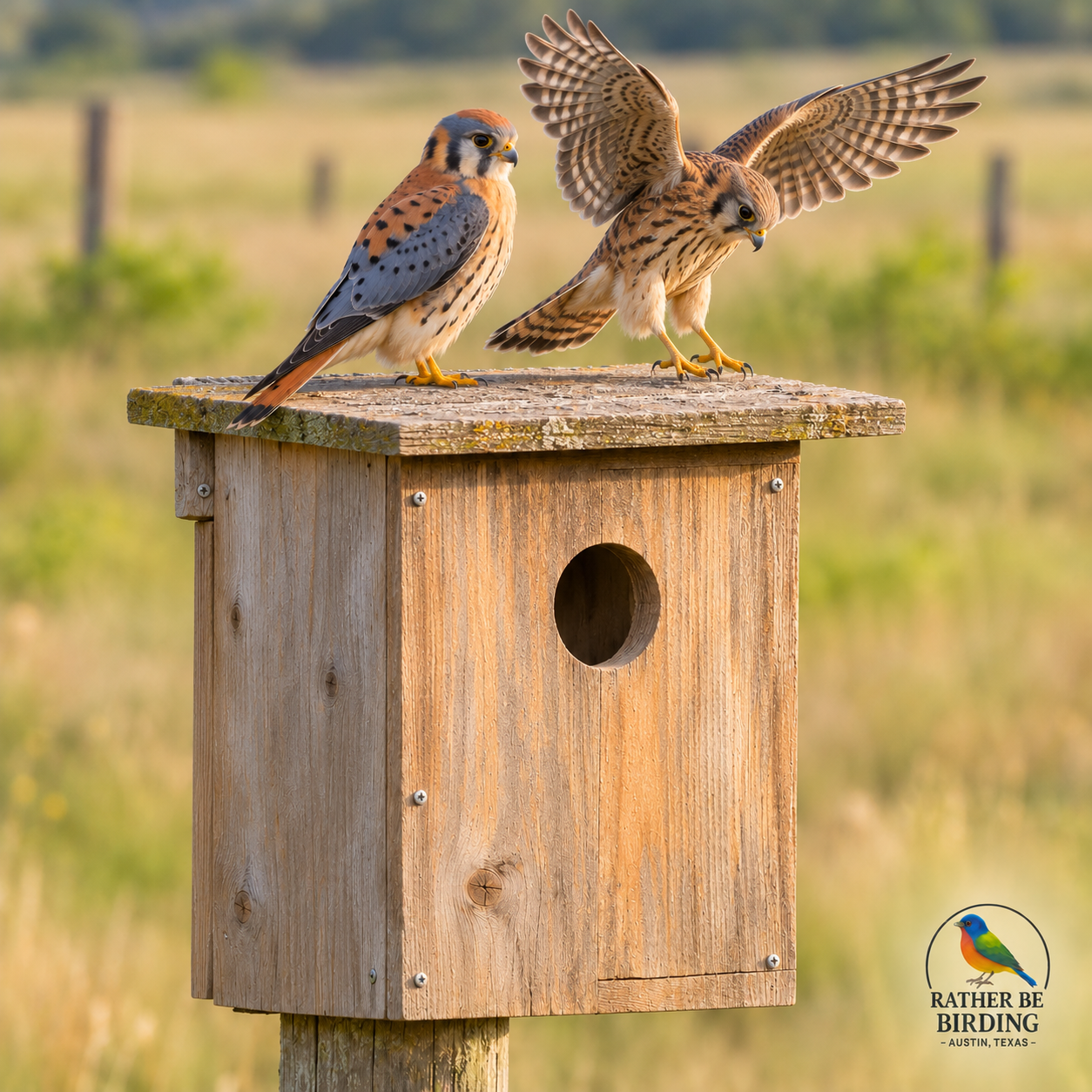
Part 2: Helping the American Kestrel population recover
The American Kestrel is a small falcon with a big presence. Watch one hover over a field or perch on a fence post and you can see the attention, speed, and precision that make it such a memorable neighbor. But as Part 1 of this series explained, kestrels have declined across much of North America. Scientists are still sorting out the causes, which may vary by region and include changes in prey, habitat, survival, and other pressures. One piece of the puzzle is the availability of safe places to nest.
Kestrels are cavity nesters. They do not build a bulky nest of twigs; they use a hollow in a tree, an old woodpecker cavity, or sometimes a suitable human-made structure. When natural cavities are scarce in otherwise useful open habitat, a well-designed nest box can offer another option. A box cannot reverse a continental decline by itself, and it cannot make poor habitat good. But when it is placed where kestrels can hunt and cared for by someone who records what happens, it can support a nesting attempt and contribute useful information.
This is the practical follow-up to Part 1: how to think about construction, placement, and monitoring—and how to make the effort count for kestrels as well as for the people studying them.
First, decide whether a box is the right next step
It is tempting to begin with a saw and a board. Start instead with the landscape and the people who will care for the box. Is there open, suitable habitat nearby? Are natural cavities already plentiful? Is a local landowner willing to host a box and allow access for maintenance and monitoring? Is there a local kestrel project that can advise on placement or use the resulting observations?
If a box is already installed nearby, helping monitor or maintain it may be more valuable than adding another. Ask a state wildlife agency, land trust, university extension office, Audubon chapter, raptor center, or nature center whether a project operates in your area. If you are in a region where habitat needs or box spacing differ, local expertise matters. The goal is not to put up the largest number of boxes. It is to provide suitable nesting cavities where they are needed and keep reliable records over time.
Building a kestrel nest box
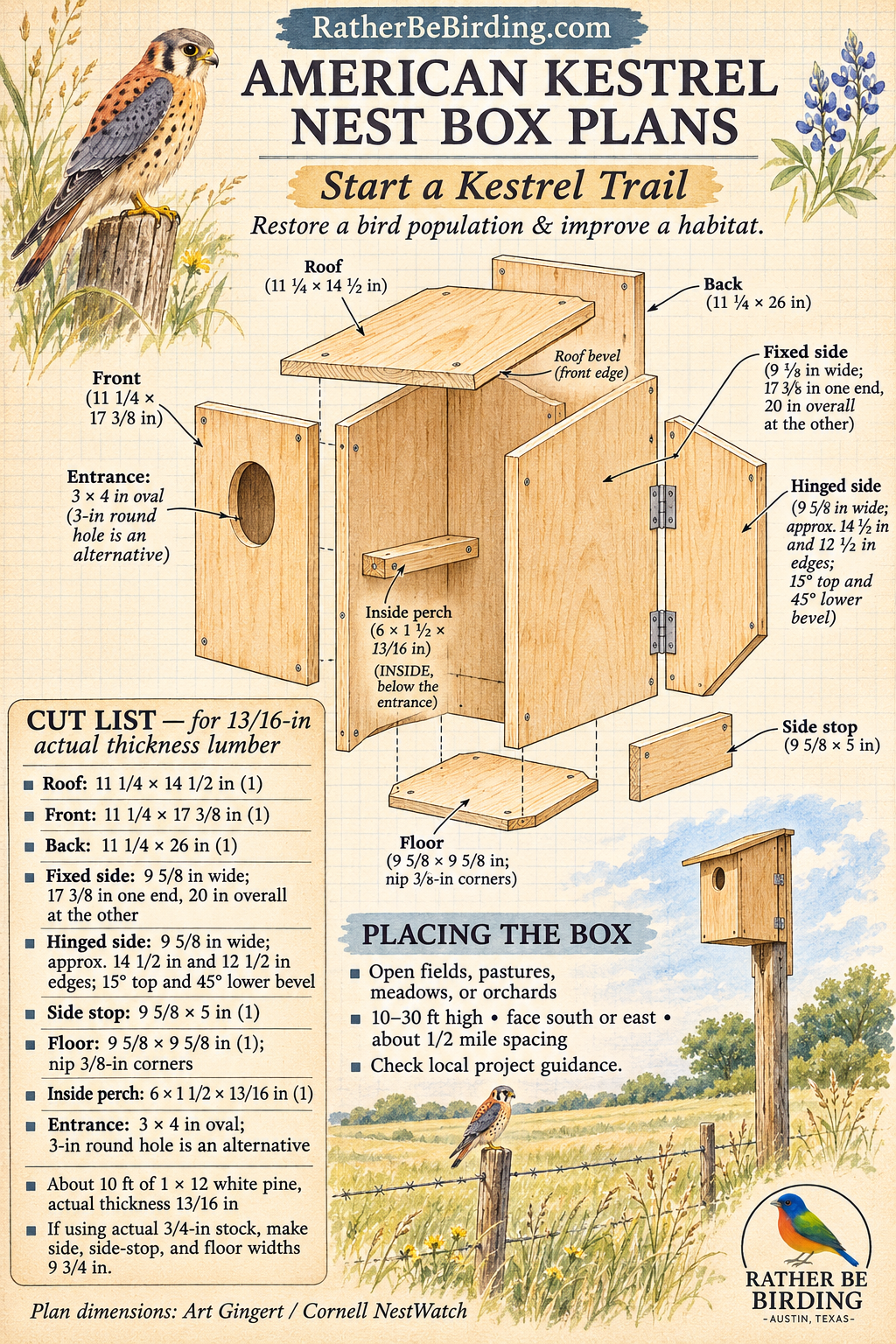
Use a plan made specifically for kestrels. Cornell Lab of Ornithology’s NestWatch provides an American Kestrel plan based on a design by Art Gingert. It specifies a roughly 3-inch entrance, an interior floor about 9 5/8 by 11 1/4 inches, and an interior depth of about 17 3/8 inches. The current plan includes a hinged side that makes inspection and cleaning easier. Follow the downloadable diagram for the exact cut list and assembly sequence; dimensions and joinery are easier to get right when you are working from the drawing at the bench.
Choose durable, untreated wood such as pine or cedar. Wood around 3/4 inch thick helps buffer temperature changes. Use exterior-grade, galvanized or corrosion-resistant screws and hinges. Do not use pressure-treated or chemically preserved wood, and do not paint or stain the inside. A box should shed rain, breathe, drain, and open securely for inspection. A sloped roof with an overhang helps keep the opening and interior drier. Drill drainage holes in the floor and small ventilation holes near the upper sides, following the plan. Roughen the inside below the entrance, or add shallow grooves, so young birds can climb toward the opening when they are ready to leave.
Do not add an outside perch. Kestrels do not need one to enter, and a perch can give predators an easier foothold. The entrance should be the plan’s specified size: too small can exclude kestrels, while an oversized hole can invite larger competitors or predators. If a box has a removable or hinged side, check that it closes tightly and cannot swing open in wind. Smooth or cover sharp edges, and make sure screws do not protrude into the cavity.
The box should be sturdy but still manageable to install and maintain. Before you climb or mount it, test the door, hinges, fasteners, and roof on the ground. Number each box with a small, unobtrusive ID, and keep a simple record of its location, installation date, design, and maintenance. A unique ID avoids confusion when more than one box is part of a project.
Choose a site for kestrels, not just a convenient post
Kestrels need a nest cavity and hunting habitat. Look for open country such as a pasture, field, meadow, orchard, or similar landscape with short or varied vegetation and nearby perches. Lone trees in fields, the edge of a woodlot, farm buildings, and sturdy posts can all work if the surrounding habitat is appropriate. A box facing a beautiful view but surrounded by dense forest is unlikely to meet a kestrel’s needs.
NestWatch’s current general guidance is to mount kestrel boxes 10 to 30 feet above the ground, face the entrance south or east, and space boxes about one-half mile apart. Treat these as starting guidelines, not a guarantee: local topography, prevailing weather, the amount of open habitat, and regional project protocols can affect what is suitable. In Florida, for example, the state wildlife agency provides regional guidance for Southeastern American Kestrels and recommends open sites, a 10-to-20-foot mounting height, and roughly half-mile spacing. Check with a local coordinator before installing boxes in a managed landscape.
Face the opening toward a relatively open flight path, while considering exposure to afternoon heat, driving rain, and strong prevailing wind. Avoid locations close to heavy traffic, frequent disturbance, or places where pets roam. Do not attach a box to a utility pole unless the utility has given written permission. Use a secure mounting method suited to the tree, building, or post, and make sure the structure can safely bear the box and be reached later for maintenance.
Think about safe access before you install. A box mounted where no one can inspect it without risky climbing may become a maintenance problem. Use a stable ladder or lift only if you are trained and equipped to do so; otherwise work with a landowner or local project that has the right equipment. Never risk a fall for a nest box. If you are installing several boxes, map each location and keep spacing and habitat notes. Avoid publishing exact locations of active nests where that could lead to disturbance.
Timing and setup
Where possible, install boxes during fall or winter, well before the local breeding season. That gives kestrels time to discover a cavity before nesting begins and lets you confirm the mounting, label, and records without disturbing an active nest. Nesting timing varies across the species’ broad range, so ask a regional project when to begin monitoring. Before the season, inspect fasteners and the roof from a safe position, and make sure the box is dry and sound.
Many kestrel boxes need a shallow layer of clean, untreated wood shavings on the floor because kestrels do not bring in a nest of twigs. Use only a small amount and follow the box plan or local project’s guidance. Do not use sawdust, cedar shavings with added fragrance, or material that is damp, moldy, or treated. If a local monitoring project has a different bedding protocol, follow that protocol so the boxes and data remain consistent.
Monitoring: the box is part of a project
Monitoring helps answer questions a nest box alone cannot answer. Did kestrels find it? Was it used by another species? Were eggs laid? Did young hatch and leave the box? How does one season compare with another? An empty box is still a result. Repeated records of occupied and unoccupied boxes help researchers understand where boxes are used and what habitat features may matter.
Part 1 explained that the community-science program once run through the American Kestrel Partnership moved to Cornell Lab of Ornithology’s NestWatch in 2024. The former AKP website is no longer active. New kestrel nest-box observations should be entered through NestWatch, following its current training, Code of Conduct, and monitoring protocol. Do not enter old observations a second time if they were already submitted through the former AKP database. People who need access to historic AKP records should contact NestWatch rather than recreating those entries.
Before the season, complete NestWatch’s certification and learn its protocol. Keep a field sheet or use the app to record each visit promptly. Record the box ID, date and time, weather or relevant conditions, whether kestrels or another species are present, and what you actually observe. When active, record the contents and outcome using NestWatch’s definitions. Be accurate; if you cannot determine something, mark it unknown rather than guessing. Submit the record even if the box was not used.
NestWatch recommends checks every three to four days, or at least weekly when a more frequent schedule is not possible. However, a local project may use a different schedule for kestrels or a particular study. Follow the protocol for the project you joined; do not check more often simply because you are curious. Prepare your notes before approaching so each visit is quick. Choose a quiet time, generally late morning or afternoon. Avoid bad weather, the first few days of incubation when possible, and visits when young are close to fledging.
Approach quietly and watch for adult behavior. If an adult is sitting inside, tap on the box first, wait, then open the door only if the bird leaves on its own. Tap again after opening so a bird inside has a chance to slip away before you look. If the adult does not leave, close the box and come back another time. Keep the visit brief—NestWatch’s general guidance is no longer than about a minute—and move away before writing notes. Avoid walking the same track to and from the box on every visit, because a repeated trail can help predators locate it.
Never handle eggs or young, and do not band birds unless you hold the required permits and training. If fully feathered young are alert near fledging, observe from a distance instead of opening the box. If you find a dead bird, injured bird, unusual parasite load, damage, or a safety issue, follow your project’s instructions and contact its coordinator. Do not improvise interventions that could harm the birds or compromise the study.
Clean and maintain the box after the season
Once you are certain the box is inactive, and the local project says it is appropriate, remove old nesting material and clean out the interior. Fall or winter is a common time for this work. Wear gloves and eye protection, use a scraper and brush, and avoid creating dust. Check the roof, drainage, ventilation, hinges, and mounting hardware. Repair loose parts and replace bedding only when the box is ready for the next season. If another species is using the box, document it and ask the project coordinator how to proceed; do not evict occupants or clean an active nest.
Maintenance matters because a weather-damaged or inaccessible box can stop being useful. But a working box is not just a little house to admire. It is a managed part of a habitat and a long-term record. That means someone needs to know where it is, inspect it safely, keep it in good condition, and share observations through the right program.
Why it is worth doing
Part 1 described the uncomfortable trend: American Kestrels remain familiar across much of North America, yet many populations have declined over decades. Researchers are examining multiple possible causes, and no single action can solve them all. Nest boxes address one specific need—the availability of nesting cavities—while monitoring can help reveal whether and how kestrels use those opportunities.
That combination makes a box project more than a weekend carpentry job. You may help provide a safe cavity in open habitat, learn which species use it, and contribute observations that join a wider record. The results can be humbling: some boxes remain empty, some attract another cavity-nesting bird, and a nesting attempt does not always succeed. That is why honest records matter. Conservation needs the unsuccessful and uneventful outcomes as much as the exciting ones.
There is also a very personal reward. You may notice a kestrel pair arriving, one bird carrying prey, or a parent returning to the box with food. You begin to see the field around the box differently: the perches, the insects, the small mammals, the management decisions, and the open space the birds depend on. The kestrel’s story helps connect a familiar roadside sighting to the health of the larger landscape.
Build carefully. Choose a site with help from people who know the local habitat. Monitor respectfully, and share what you learn. A box by itself is a small intervention; a well-sited box supported by ongoing care and good data becomes part of a larger conservation effort. That is a meaningful way to help keep this little falcon in the places where we still expect to see it hovering over a field.
Skill Builder: plan a box before you build
Choose one possible site and make a short site note. Describe the surrounding habitat, nearby perches, likely access for maintenance, possible disturbance, and how far the closest known kestrel box may be. Take a photograph from a respectful distance if no nest is active. Then contact a local conservation group or NestWatch and ask whether the location and monitoring plan fit regional needs. Before cutting wood, learn the protocol you will use to record the box’s outcome.
Take the next step
If you are ready to help, download the accompanying kestrel nest-box construction plan, then contact a local landowner or monitoring project before choosing a site. Part 1 explains why kestrels need our attention; this guide shows how to turn that concern into a careful, useful project. If building is not the best fit for you, ask a local group whether it needs monitors, maintenance help, or support entering records in NestWatch. Every reliable observation and every well-planned cavity can add one more piece to what we know about bringing kestrels back.


An oak is more than a source of acorns. It leaves feed caterpillars for nestlings, its bark and branches offer food and shelter, and its fallen leaves keep a busy world beneath the tree. Learn how birds use oaks, how long they take to grow, and which native oaks to consider in your region.