

Why Birders Keep Lists
The Art, Joy, and Practical Magic of Tracking Every Species You See
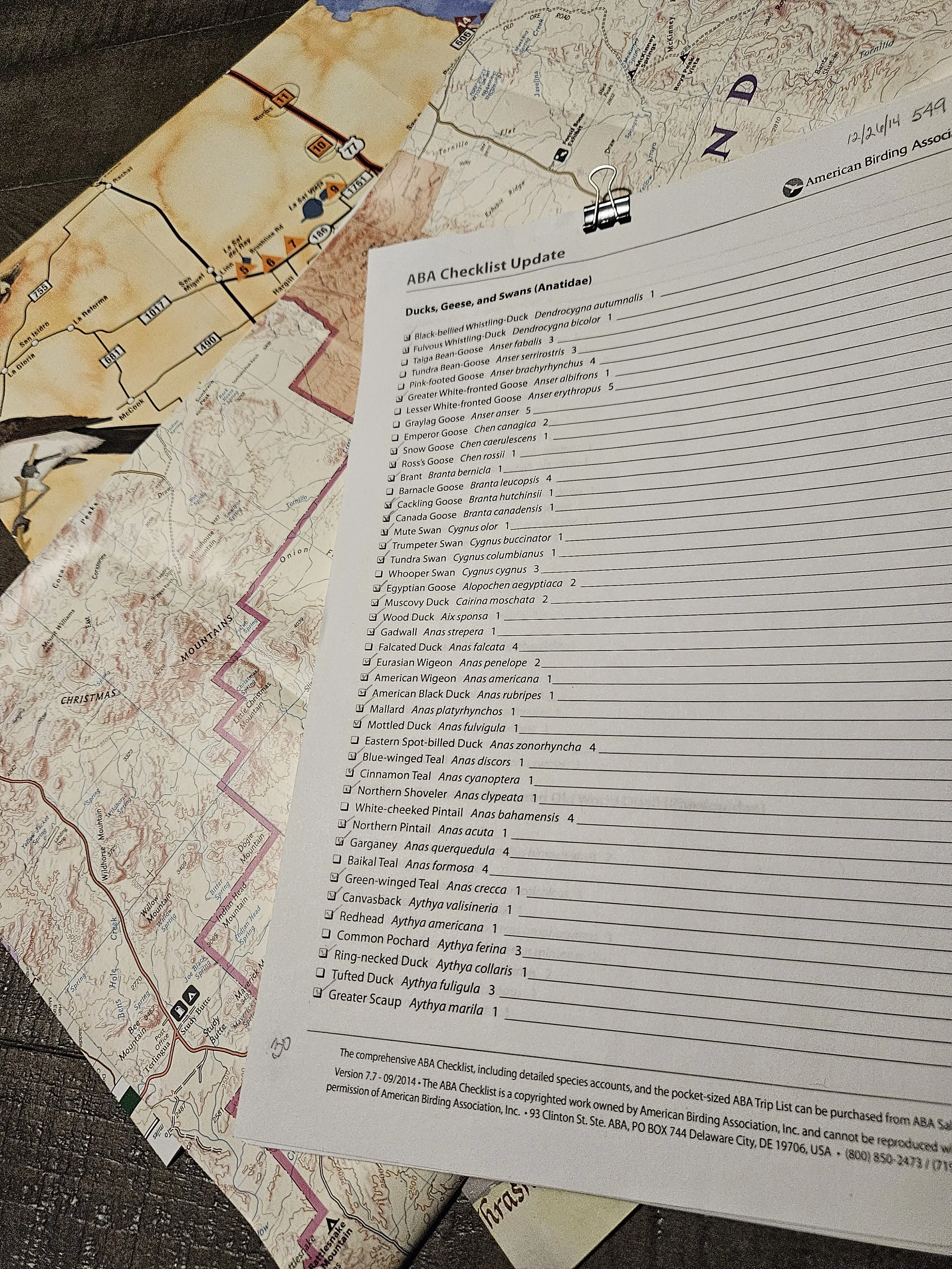
Birding has many charming quirks, but none is as universally beloved—or universally debated—as bird lists. Life lists, yard lists, county lists, year lists, patch lists, state lists… birders don’t just keep one list; they keep dozens. And each list tells a different story about who we are as birders, where we’ve been, and how deeply we pay attention.
This post is part of a cluster with my January birding article and upcoming posts about planning bird trips, setting goals, and contributing to citizen science. Think of this one as the foundation: an ode to the art of listing, and a practical guide to how lists help us grow as birders.
Most of us birders can tell you the place and circumstances of each of our significant lifers but with 1100+ species to keep track of listing has a very practical use as well. I’m an old birder now and without prompting, I have trouble remembering some of my first encounters but my life list helps spark my memory and always brings me a smile, ”Remember when we got that Bare-necked Tiger Heron?” and a story ensues.
From the outside, it may seem obsessive—Why write down every bird? Why track dates and locations year after year? But birders know the truth:
Listing isn’t just record-keeping. It’s memory-keeping. It’s pattern-finding. It’s motivation. And it’s one of the best tools we have for becoming better birders.
And yes… it can be a little competitive, too.
What Is a Bird List? More Than a Checklist—It’s a Personal Story
At its core, a bird list is simply a tally of the species you’ve observed. But in practice, it’s much more. A list is a living document that expands every time you lift binoculars to your eyes. It tracks:
First sightings
Last sightings
Migration patterns
Where and when certain species appear
Changes over the years in your yard, county, region, and life
For many birders, lists become a chronicle of their birding life—a timeline of discovery shaped by seasons, travel, and even personal milestones.
Some birders keep meticulous notes in a journal. Others track sightings in eBird or on the Sibley Life List. Many do both. But almost all agree: listing deepens the connection to the birds we see and the places we visit.
The Many Lists Birders Keep (and Why They Matter)
One list is never enough. Why? Because different lists tell different stories.
✔ Life List
Your life list is the grand total of every bird species you’ve ever seen. For many, it’s the first list they start—it grows slowly at first, then more rapidly as skills develop.
Why it matters:
A life list reveals your long-term growth as a birder, your travel history, and your expanding knowledge of bird families and habitats.
✔ Year List
January 1 resets everything. Suddenly a House Sparrow is as valuable as a Snowy Owl, because both earn you your first checkmark of the year.
A year list is thrilling because it turns familiar birds into new achievements.
Why it matters:
Encourages year-round observation
Motivates birders to get outside during slow months
Creates an annual snapshot of local bird activity
Helps identify long-term patterns like when do hummingbirds return each year? (Answer: in my yard they return March 16-18 every year. Feeders go up March 14)
✔ Yard List
For many birders, the yard list is the most personal—and sometimes the most exciting. Nothing beats the surprise of a migrating warbler or unexpected flyover that transforms an ordinary morning into a memorable one.
Why it matters:
Yard lists show the subtle but meaningful shifts in migration, habitat, weather patterns, and even climate over many years.
✔ County & State Lists
These lists keep birders exploring their local community. They help birders get to know parks, refuges, and backroads they might otherwise never visit.
Why they matter:
Build knowledge of regional bird distribution
Help identify reliable hotspots
Support better local conservation efforts
Create an annual tradition of “county birding” for many birders
✔ Patch Lists
Some birders choose one patch—maybe a neighborhood park, trail, or lake—and bird it frequently. A patch list can become surprisingly long as seasons change.
Why it matters:
Patch birding trains your eyes and ears. The more familiar you are with an area, the quicker you notice changes and rarities.
✔ Trip Lists
Heading to High Island, the Rio Grande Valley, Cape May, Sax-Zim Bog, or your favorite national park? Every birding trip deserves its own list.
Why it matters:
Trip lists help with future planning, travel timing, species targeting, and tracking “must-see” birds you may have missed.
Is Bird Listing Competitive? Yes. Is That a Bad Thing? Not at All.
Bird listing has a lighthearted competitive streak. Most birders know about Big Years, where individuals race to see as many species as possible in a calendar year. There are also Big Days, county challenges, patch challenges, and friendly competitions among local bird clubs.
The competitive side:
Pushes birders outdoors more often
Sharpens identification skills
Encourages exploration of new habitats
Builds community as birders share sightings (“Go now! The Vermilion Flycatcher is still there!”)
But listing is only competitive if you want it to be. Many birders aren’t competing with anyone but themselves. For most, keeping lists is simply a structured way to stay curious.
The Practical Benefits of Keeping Bird Lists (This Is Where Listing Becomes Powerfully Useful)
Birders experience something few people understand: after seeing hundreds (or even thousands) of species, it becomes genuinely challenging to remember exact dates and locations.
Most birders can recall their lifers, because those birds are emotional memories. But the fourth time you saw a Black-and-white Warbler? Or which pond the Northern Pintail was in last December? Or when exactly the first hummingbird arrived in your yard last spring?
This is where lists shine.
1. Listing Improves Identification Skills
When you write down a species, you strengthen your recognition of:
Plumage variations
Behavior
Voice
Preferred habitats
Seasonal patterns
Listing forces you to observe deeply, not casually.
2. Lists Provide Location Data You’ll Use for Years
A well-kept list includes not just the species name but where you saw it. That information becomes invaluable when planning future bird outings.
Example:
If you saw American Bitterns three years in a row at the same marsh in April, guess where you’ll check first next spring?
3. Lists Track First and Last Seasonal Dates
These dates help birders understand long-term migration patterns:
When did the first Ruby-throated Hummingbird arrive this year?
When did the final Scissor-tailed Flycatcher depart last fall?
Are certain species showing up earlier than in previous decades?
This information is the backbone of many scientific studies—and your personal records contribute to the bigger picture, especially when logged through eBird.
4. Lists Reveal “Gaps” in Your Birding Knowledge
Many birders use their lists to set goals:
“I’ve never seen a Nelson’s Sparrow. Time to plan a fall marsh trip.”
“I need one more woodpecker to complete the regional set.”
“Why don’t I have more shorebirds on my county list? I should explore new wetlands.”
Listing isn’t just documentation—it’s motivation.
5. Lists Provide a Meaningful History of Your Birding Life
Years from now, your lists will hold memories:
The day you saw your first Pileated Woodpecker
The morning your yard list jumped by three during migration
The family trip where you finally saw your target lifer
The January 1st Big Day traditions you’ve created
Bird lists preserve moments you might otherwise forget.
Listing as a Tool for Citizen Science
One of the most important reasons to keep lists—especially digital ones—is the contribution they make to science.
Every data point in eBird helps build a more complete picture of:
Migration timing
Population trends
Rare bird occurrences
Habitat needs
Climate change impacts
Birders provide millions of records each year. Your lists, especially when they include dates and precise locations, truly matter.
And they help researchers protect the very birds we love to watch.
How Birders Keep Their Lists: Digital, Paper, or Both
There’s no right way to keep lists, and most birders mix and match depending on the list’s purpose.
Digital Tools (eBird, Apps, Online Journals)
Best for:
Accurate location data
Automatic life/year/county totals
Contributing to citizen science
Quick mobile checklists
Paper Field Diaries and Journals
Best for:
Personal notes
Behavior observations
Seasonal changes
Sketching or noting identification questions
A slower, more mindful birding experience
Hybrid Listing
Many birders log sightings digitally for data accuracy and keep a paper journal for reflection.
Why Listing Pairs Perfectly With January Birding and Yearly Goal Planning
January is the great reset for birders. A new year list begins. Every species counts again. And it’s the perfect time to organize your existing lists or start fresh with new ones.
Because this blog is cluster-linked with your January post, trip-planning post, and future goal-setting article, here’s how listing fits into the bigger birding picture:
✔ January: Start Fresh & Assess Patterns
Review last year’s lists:
Which species arrived early or late?
What habitats did you bird most?
Which months were your slowest?
Use that data to shape your year.
✔ Trip Planning: Let Lists Show You Where to Go
Your lists may reveal:
Which species you still need for the year
Where you consistently find shorebirds, warblers, raptors, or ducks
Which hotspots are worth revisiting
Listing helps turn vague goals (“see more gulls”) into targeted plans.
✔ Citizen Science: Your Lists Are Data
Every entry you record—especially digitally—adds to the scientific body of knowledge that helps conserve bird populations.
Listing isn’t just for fun. It’s a meaningful ecological contribution.
The Joy of Listing: A Hobby Inside a Hobby
At the end of the day, listing transforms birding.
It turns an ordinary walk into a treasure hunt.
It turns a familiar backyard into a scientific study site.
It turns a long-term hobby into a deeply personal journey of learning and discovery.
Birders keep lists because birds matter.
Because memory matters.
Because patterns matter.
Because conservation matters.
And because there’s nothing quite like the thrill of adding a new species—no matter how common—to a fresh list on January 1st.
This post is part of our January Birder’s Reset series. If you haven’t already, start with January Is a Birder’s Favorite Month and Planning Birding Trips. Up next: Setting Birding Goals and How Birders Contribute to Citizen Science.
