

The Shrub Layer: The Hardworking Middle of a Backyard Bird Sanctuary
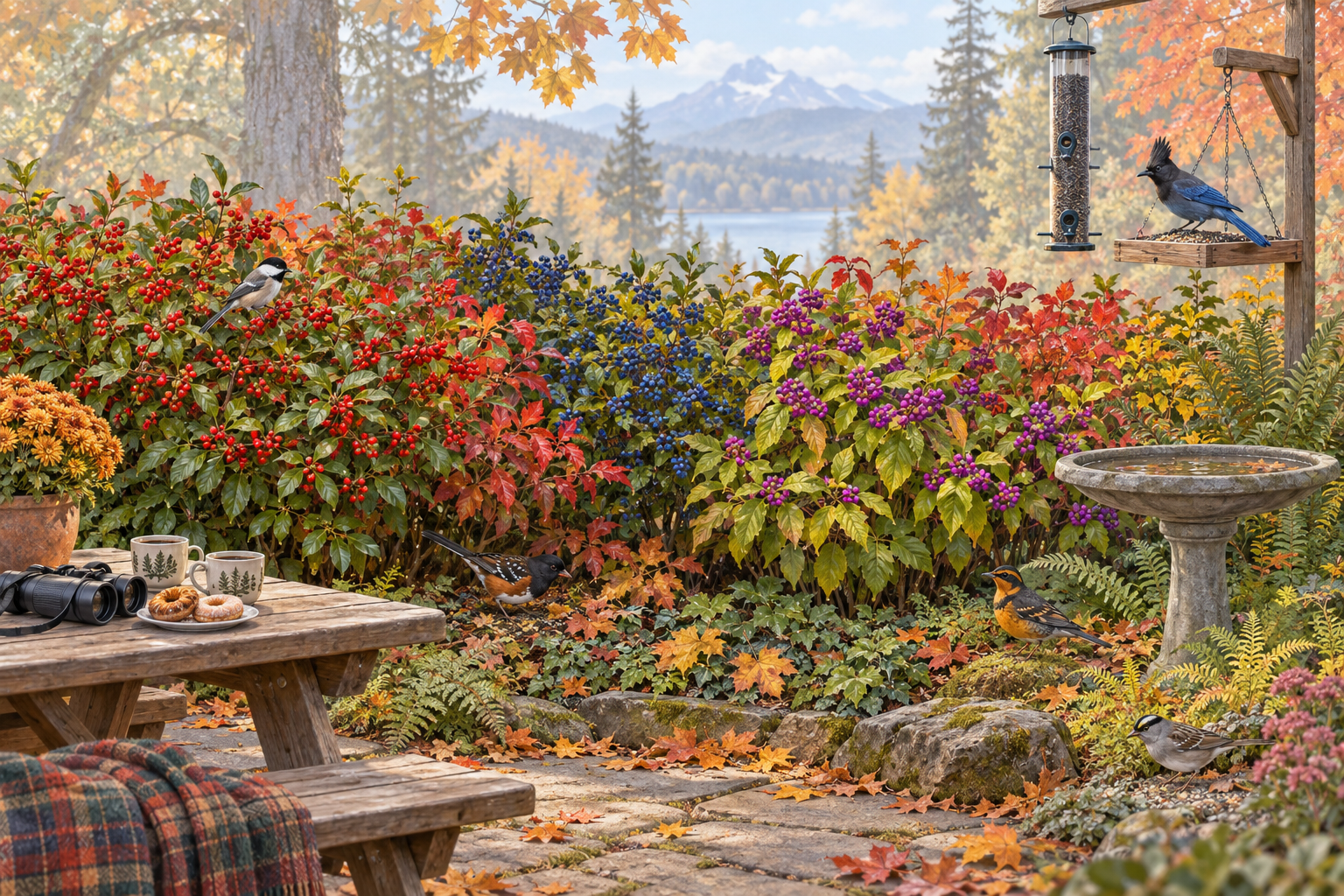
How native shrubs add food, cover, nesting places, and year-round life to the space between flowers and trees
Walk through a natural woodland edge and you will rarely see tall trees rising out of a neatly mowed floor. Between the ground and canopy is a busy middle layer of shrubs, young trees, vines, and tangled branches. That mid-level growth may not be as dramatic as a mature oak or as colorful as a bed of wildflowers, but for many birds, it is where much of life happens.
A successful backyard bird sanctuary needs this middle layer. Shrubs give birds places to hide, hunt, rest, nest, and move safely through the yard. They also produce flowers, berries, seeds, and leaves that support butterflies, moths, and the caterpillars birds depend on. If your yard already has trees and flowers but still feels strangely quiet, the missing piece may be the space in between.
Why the Middle of the Yard Matters
We often plan landscapes from a human point of view. We want a shade tree, a clear lawn, a foundation planting, and a few flowers where we can see them. Birds experience that same yard as a series of distances and risks. A wide stretch of open lawn offers little protection. A feeder standing far from cover may provide food, but it can also leave a bird exposed. A canopy that begins fifteen feet above the ground is useful to some species, yet unreachable or uncomfortable for others.
Shrubs connect those separate pieces. They create stepping-stones between a flower bed, water source, feeder, fence line, and tree canopy. Chickadees, wrens, cardinals, towhees, sparrows, thrushes, and migrating warblers can pause in the branches, scan for danger, and move again. Even birds that normally feed on the ground or high in trees may use the shrub layer as a safe waiting room.
Dense shrubs also soften weather. Their branches break up the wind, their foliage creates shade, and evergreen or semi-evergreen species provide protection when deciduous plants are bare. During migration, a tired bird does not need a decorative specimen surrounded by mulch. It needs a place where it can disappear for a few minutes without leaving the food supply behind.
A Shrub Is More Than a Berry Bush
Berries are an obvious reason to plant shrubs for birds, and they are important. Serviceberries, dogwoods, viburnums, hollies, beautyberries, currants, chokecherries, and many other native shrubs offer fruit at different points in the year. A mixture is more valuable than a row of one species because fruit does not all ripen—or disappear—at once.
But the less visible food may matter even more. Native shrubs support insects that have evolved alongside them. Butterflies and moths need particular host plants on which their caterpillars can feed. Those caterpillars, along with spiders and other small invertebrates, become essential food for nesting birds and their young. A shrub may look as though it is merely providing leaves and branches while quietly operating as a small food web.
This is why a shrub that shows a few chewed leaves is not necessarily failing. In a sanctuary, some leaf damage can be evidence that the plant is doing its job. Avoid broad-spectrum insecticides, systemic pesticides, and plants treated with neonicotinoids whenever possible. A landscape cannot support insect-eating birds while being managed to eliminate insects.
Flowers add another layer of value. Spring-blooming shrubs can supply early nectar and pollen. Summer bloomers carry pollinators into the hotter months, and late flowers help butterflies and bees prepare for migration or winter. Hummingbirds may visit tubular blooms, while other birds benefit indirectly from the insects drawn to the plant.
Plant Communities, Not Lonely Specimens
One of the simplest ways to make the shrub layer more useful is to plant in groups. Three compatible shrubs allowed to grow together usually provide more shelter than three shrubs spaced across the yard like individual decorations. The goal is not an overgrown wall. It is a loose thicket with overlapping branches, varied heights, and openings birds can enter quickly.
Begin along an existing edge: a fence, the border of a tree canopy, the back of a perennial bed, or a corner where lawn serves little purpose. Use taller shrubs toward the back and lower, spreading forms toward the front. Let native grasses, sedges, ferns, or shade-tolerant flowers fill the ground beneath them. If space allows, connect this planting to a tree or another shrub group rather than leaving it as an isolated island.
Choose plants for the conditions you actually have. Sun-loving shrubs forced beneath a dense canopy will become thin and weak. Moisture-loving buttonbush will not thrive in a dry, fast-draining slope without extra care. A drought-adapted desert shrub may resent rich soil and frequent irrigation. Before buying, note the hours of sun, drainage, mature width, soil, local rainfall, and whether deer are regular visitors.
Plan for mature size instead of relying on constant pruning. Frequent shearing turns shrubs into dense shells with bare interiors, removes flowers and fruit, and can destroy active nests. When pruning is necessary, do it selectively and first check carefully for nesting birds. Leave some lower branches and interior density. The feature that looks a little untidy to us may be exactly what makes a cardinal or wren feel secure.
Build a Four-Season Shrub Layer
A sanctuary works best when it offers something in every season. Start with bloom time. Include an early-flowering shrub, a summer bloomer, and—where your region allows—a late source of nectar or pollen. Then consider when fruit ripens. Soft summer fruit can feed breeding birds and newly independent young. High-fat fall fruits help migrants refuel. Persistent winter berries become more valuable after easier foods have been eaten.
Structure matters in winter too. Mix deciduous shrubs with at least one locally native evergreen, semi-evergreen, or densely twigged species when appropriate. Hollies, wax myrtles, junipers, manzanitas, and other regional choices can offer both food and shelter, but no one plant is native everywhere. Diversity is safer than building the entire layer around a single species.
If a shrub is dioecious—male and female flowers occur on separate plants—you may need both sexes to produce fruit. Hollies are the familiar example. Ask the nursery how many female plants one male can pollinate and whether their bloom times overlap. Also ask for the straight native species or a wildlife-value cultivar. Some ornamental selections have altered flowers, sterile fruit, or foliage that supports fewer insects.
Short Regional Lists to Get You Started
Native ranges do not follow the broad borders we use on maps. Treat these as starting points, then confirm that a species is native to your county or ecoregion and suited to your particular site. The Audubon Native Plants Database, National Wildlife Federation Native Plant Finder, Lady Bird Johnson Wildflower Center, state native-plant societies, and Cooperative Extension offices are excellent places to check.
Northeast and Mid-Atlantic: Spicebush (Lindera benzoin) offers early flowers, fall fruit, and leaves used by spicebush swallowtail caterpillars. Arrowwood viburnum (Viburnum dentatum) supplies flowers, blue-black fruit, and dense cover. Winterberry holly (Ilex verticillata) holds bright fruit into the cold season when both male and female plants are present. Highbush blueberry (Vaccinium corymbosum) provides spring flowers, summer fruit, and strong fall color.
Southeast and South-Central: American beautyberry (Callicarpa americana) forms graceful thickets and produces purple fruit eaten by many birds. Yaupon holly (Ilex vomitoria) offers evergreen shelter and winter berries when both sexes are planted. Wax myrtle (Morella cerifera) provides dense cover and waxy fruit for winter birds. Carolina rose (Rosa carolina) supports pollinators, offers protective branching, and produces hips. In wetter ground, buttonbush (Cephalanthus occidentalis) is a butterfly magnet whose seed heads also interest birds.
Midwest and Great Plains: Nannyberry (Viburnum lentago) is a large shrub with flowers, fruit, and good nesting structure. American hazelnut (Corylus americana) creates thickets and feeds wildlife with nuts. Fragrant sumac (Rhus aromatica) is a lower, spreading choice with early flowers and red fruit. Gray dogwood (Cornus racemosa) forms dense cover and produces white berries on colorful stems. Chokecherry (Prunus virginiana), where space permits, supports insects and bears fruit relished by birds.
Texas and the Desert Southwest: Agarita (Mahonia trifoliolata) provides tough evergreen cover, early flowers, and red berries in its native range. Desert hackberry (Celtis ehrenbergiana) offers dense, thorny refuge and orange fruit. Native wolfberries (Lycium species) provide flowers and berries in arid landscapes. Apache plume (Fallugia paradoxa) supplies flowers for pollinators and airy seed heads. Autumn sage (Salvia greggii) is a smaller, long-blooming shrub that draws hummingbirds and butterflies; combine it with a larger fruiting shrub for stronger bird habitat.
Rocky Mountain and Intermountain West: Saskatoon serviceberry (Amelanchier alnifolia) offers spring flowers and summer fruit. Golden currant (Ribes aureum) supplies fragrant blooms followed by berries. Woods’ rose (Rosa woodsii) creates cover, pollinator flowers, and rose hips. Common snowberry (Symphoricarpos albus) provides a twiggy shelter layer and persistent fruit. Chokecherry is also valuable across much of this region where its mature size and suckering habit have room.
Pacific Northwest and coastal West: Red-flowering currant (Ribes sanguineum) is an important early nectar source and later bears fruit. Oceanspray (Holodiscus discolor) supports native pollinators and several butterflies and moths. Common snowberry adds dense branching and winter fruit. Evergreen huckleberry (Vaccinium ovatum) offers year-round cover, flowers, and edible berries in its native range. In California, look locally at coffeeberry (Frangula californica), toyon (Heteromeles arbutifolia), manzanitas (Arctostaphylos species), and California lilacs (Ceanothus species), matching each carefully to soil, fire considerations, and ecoregion.
Make One Good Edge First
You do not need to rebuild the whole yard this year. Choose one underused edge and add a small community of shrubs with different jobs: one for dense shelter, one for fruit, and one that blooms for pollinators or hosts caterpillars. In a small yard, a single well-placed grouping can be more valuable than many isolated plants.
While the shrubs establish, water them appropriately, protect them from browsing if necessary, and give fallen leaves permission to remain beneath them. Leaf litter shelters insects and enriches the soil; the birds will investigate it too. Keep cats indoors, reduce pesticide use, and add a nearby water source to make the area even more useful.
Then watch. You may first notice a butterfly testing the flowers, a chickadee searching the leaves, or a sparrow slipping beneath the branches. Over time, the once-empty middle of the yard becomes a place of movement. That is the real measure of a successful shrub layer: not how perfectly it is clipped, but how many small lives can use it.
A backyard sanctuary is strongest when the ground, shrub, trunk, and canopy layers work together. Trees give the yard height. Flowers bring color and nectar. But shrubs make the connection. Fill that middle space thoughtfully, and your yard will begin to feel less like landscaping with a few visiting birds—and more like habitat. Read the Complete Backyard Bird Sanctuary Guide for more information.
