

Birding for Beginners — Part 2
Training Your Eyes, Ears & Awareness

Birding begins with curiosity—an instinctive pull toward the natural world and a desire to understand it at a deeper level. If Part 1 of this series helped you choose binoculars, field guides, and apps, Part 2 helps you use your senses more intentionally.
Because birding is far more than simply “seeing birds.” It is noticing everything around you—the breeze in the trees, the patterns of light on water, the subtle shifts of movement, the flashes of color, and the chorus of sounds you’ve passed by a thousand times without truly hearing.
This installment helps you slow down, pay attention, and learn to notice the details that transform casual bird-watching into skillful birding.
Why Noticing Details Matters in Birding
Every great birder—no matter how confidently they identify species today—began by learning to notice.
Noticing is the foundation of all birding skills. Before you can identify a bird, you must first sense that it’s there. Before you can understand behavior, you must watch it unfold. Before you hear the difference between two species’ calls, your ears must grow comfortable listening to nature’s quieter layers.
Most importantly, noticing helps you feel present. That sense of being here, in this moment, fully awake to the natural world, is one of birding’s greatest gifts.
Birding sharpens your awareness of:
Movement
Color
Pattern
Sound
Light
Shadow
Shape
Behavior
Habitat
When these come together, even beginners can suddenly “see” what used to be invisible.
[Sometimes it’s about “thinking like a bird.” Skip and I were with a group of fellow birders walking up a canyon in hopes of securing a look at a rare warbler — the Rufous-capped Warbler — near Government Canyon, Texas. We found “a” bird who stayed hidden in the tall grass and chased it up the canyon for a hundred feet or so. It finally occurred to me we were simply “herding” it further up so I quietly walked ahead of the bird and said to myself “which way would I go if I were a tiny warbler?”. And that’s the direction I walked. One of my favorite “Northern Exposure” tv episodes taught me to “think like a fish” so I changed the species and used the principle.
Thirty feet ahead of the group, I signaled to my husband to join me and we sat and waited. Within a minute the bird popped up on a tall stalk and we got great views of a beautiful and rare bird and made sure all the group got clear sightings as well. By reacting as a bird might I was able to get the sighting without continuing to stress the bird by chasing it. This doesn’t work every time nor am I always that intuitive but I was glad to not cause additional stress to this amazing little creature.]
Let’s explore how this works.
How Birds Hide in Plain Sight
If you’ve ever wondered how a bright red Northern Cardinal can disappear instantly into a shrub, or why a Great Egret can stand like a statue for minutes at a time, or how that leaf that isn’t swaying like all the others isn’t a leaf, it’s a bird. You’re already beginning to train your mind to look deeper.
Birds have evolved to blend into their habitats. That bright male cardinal becomes surprisingly hard to spot once he turns his back, showing muted colors instead of blazing red. An egret’s stillness makes it nearly indistinguishable from a broken tree branch. A yellow warbler vanishes into the shadows when it senses danger after sitting atop the shrub singing loudly to proclaim its territory.
These are not random moments—they are clues.
Movement: The Beginner Birder’s Best Friend
The human eye (as well as the predator’s) is naturally sensitive to motion. Birds know this, so they minimize movement when threatened or while foraging.
As a birder, you can take advantage of this:
Look for one leaf moving when the rest of the branch is still. And the opposite.
Notice the flick of a tail or the quick turn of a head.
Watch for the dip of a cattail or the ripple in tall grass.
Scan for shadows—sometimes you see the bird’s movement before the bird itself.
One of the most important transitions in beginning birding is learning to scan slowly and patiently, letting movement reveal what your eyes would otherwise skip right over.
You become a detective adding up the behavior you have studied from the field guide with the clues you notice in the field to determine what bird you are looking at right now. The more info you have at your disposal, the better you will be at solving the “case of the unknown bird.” It provides a sense of accomplishment and enjoyment that no phone app ID or asking people on social media to ID a bird for you can provide.
“Birding isn’t only about noticing what fits that moment—sometimes it’s about noticing what doesn’t.”
When Stillness Is the Clue
Some birds don’t advertise their presence at all. Egrets, herons, and bitterns, for example, use stillness as a hunting strategy. They stand motionless until a frog or fish swims within reach. Bitterns also use stillness to thwart detection.
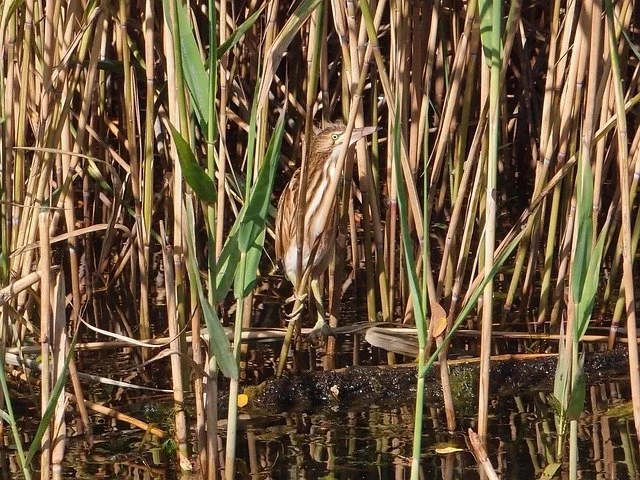
When you watch a Great Egret long enough, something interesting happens:
Its stillness becomes shape, and shape becomes pattern recognition.
You begin to see:
The curve of its neck
The angle of its bill
The length of its legs
The color contrast between body and beak
The subtle sway as it maintains balance
These details become part of your visual memory bank, making identification much easier the next time you encounter a similar silhouette.
“Birding isn’t only about noticing what moves—sometimes it’s about noticing what doesn’t.”
Learning to See Field Marks
As you grow as a birder, you’ll begin to recognize something called field marks—identifying features that help you distinguish one bird from another.
For most species, field marks include:
Wing bars
Eye rings or eye lines
Face patterns
Tail length and shape
Bill size, shape, and color
Leg color
Spots or streaks on the breast
Patches of color on wings or crown (like warblers or woodpeckers)
Often the surprise of seeing a bird and the beauty of it, throws us as new birders. We forget to start noting the field marks — double wing bars, red legs, brown bib. Developing the new habit of immediately noting field marks can turn a “what was that?!” into a “Oh wow! Lazuli Bunting! Look at the rust on the chest!”
These details seem impossibly small when you’re starting out, but you’ll be amazed at how quickly your eyes learn to see them.
A helpful trick for beginners: Compare, don’t memorize.
Rather than trying to remember every possible field mark of every species, focus on what’s different between two birds you’re likely to confuse.
For example:
Downy vs. Hairy Woodpecker
House Finch vs. Purple Finch
Lesser Scaup vs. Ring-necked Duck
Song Sparrow vs. Lincoln’s Sparrow
Once you notice the contrast, your brain holds onto the pattern.
Skill-Building Exercise #1: The 10-Minute Quiet Practice
One of the best exercises for new birders costs nothing, requires no equipment, and can be done almost anywhere:
A daily 10-minute quiet sit.
Think of this as gentle sensory training—similar to meditation—with the goal of simply noticing.
Here’s how it works:
Sit comfortably in a park, your backyard, your balcony.
Be still for just one minute. Let your breathing settle.
Close your eyes and listen.
What sounds are closest?
What is faint but persistent?
Are there birds calling? Chirping? Singing?
Can you pick out more than one song? Songs are sustained while a chirp (aka call note) is usually single chip that birds use to keep track of each other and to communicate safety.
Now open your eyes and look without rushing.
What is moving?
What is still?
Which objects catch the light?
Does anything seem out of place in the pattern of leaves, branches, or grass?
Notice without labeling.
Identification comes later. For now, you're simply training your senses.
Do this for 10 minutes a day for two weeks, and you will become a markedly better birder.
Skill-Building Exercise #2: Ducks as Your Training Partners
If you live near a pond, wetlands, river, or lake—especially one that stays open in winter—ducks offer one of the easiest and most enjoyable ways to build your field skills.
Ducks sit still more often than songbirds. They float, preen, nap, and forage without darting off unless disturbed. This makes them perfect for practicing with binoculars.
Why ducks are ideal for beginners
They’re large enough for easy viewing.
They stay in the open, especially in winter.
They show clear field marks, especially males in breeding plumage.
They often group together, encouraging comparison between species.
They demonstrate obvious differences between males and females.
A male Mallard with his emerald green head and curly tail feathers looks entirely different from the mottled-brown female beside him. The same is true for Northern Shovelers, Buffleheads, Redheads, or Hooded Mergansers.
Don’t forget to compare the females to each other to learn their differences.
How to Practice with Ducks
Bring your binoculars and take your time.
Focus on steadying the view. Ducks are patient birds; they won’t fly off the moment you blink.Practice tracking.
As ducks swim, match their movement with a slow, smooth panning motion. Try not to move your binoculars in jerky starts.Study feather patterns.
Even “plain brown ducks” have beautiful, intricate patterns. Notice:Scalloped edges
Contrast between flank and back
Bill color
Speculum (iridescent wing patch)
Compare multiple species.
Look for shape differences:Which one has a larger head?
Which has a more rounded body?
Which sits lower or higher in the water?
This exercise builds essential skills: detail recognition, patience, binocular control, and confidence.
Next step will be to learn the difference between the diving ducks and the dabblers.[Stay tuned]
Letting the Natural World Teach You
Birding is not just about the birds—it’s about how your awareness opens up.
The way wind runs through grass
You begin to notice the rhythm of movement. Tall grasses bend in waves, but a single stiff stalk may remain upright—often because a small creature is climbing it.
The way sun hits feathers
Colors that looked flat become iridescent. A starling turns from “dark” to glowing greens and purples. A Blue Jay’s feathers reveal thousands of tiny structures refracting light.
The way shadows reveal presence
Sometimes the first clue to a bird’s presence is not the bird at all, but the subtle movement of its shadow on a branch or rock.
The way sound layers in the environment
At first all chirping sounds alike. But over time, your brain begins separating them naturally:
High, thin calls
Buzzy insects
Repetitive songs
Whistles
Chips
Distant caws and honks
This is how birders start recognizing species before they ever see them.
Becoming Present: The Unexpected Personal Benefits
One of the most beautiful things about birding is that it pulls you gently into the present moment.
Birding becomes a meditation practice, whether you intend for it to be or not.
You become more observant in daily life. You notice weather patterns, cloud formations, seasonal cues, and animal behavior. Many birders say birding has made them calmer, more patient, and more connected to something bigger than themselves.
A few benefits new birders often report:
Reduced stress
Feeling more grounded
Better focus
A stronger connection to nature
Joy in small discoveries
A sense of purpose in noticing and protecting wildlife
Birding reminds us that life is happening all around us—all the time—and we get to be part of it.
How to Practice Noticing in Everyday Life
You don’t have to be on a trail, at a lake, or in a forest to strengthen your birding skills.
At Home
Watch how birds approach a feeder.
Notice who waits in the shrubs before landing.
Listen for alarm calls when a hawk passes by.
Compare morning bird activity to late afternoon.
At Work
Look out the window at lunch and observe the movement of trees.
Notice shadows of flying birds crossing sidewalks or buildings.
Listen for city birds—pigeons, sparrows, starlings, crows—and try to distinguish their calls.
At a Park
Sit quietly.
Observe everything, not just birds.
Notice how time changes the scene: light, sound, movement.
On a Walk
Pause occasionally and let the landscape come to you.
Are animals responding differently as you move through their space?
Are birds alert, relaxed, feeding, or territorial?
Every moment is an opportunity to develop your awareness.
Practice Makes Better (Not Perfect)
Birding is a journey that unfolds over years, not days. The goal is not perfection—it’s connection.
You are learning an ancient skill practiced by humans long before field guides, optics, or apps existed. And you’re learning it the same way they did: by paying attention.
The more you notice, the more the natural world reveals.
And once it does, you never see the world quite the same again.
What’s Ahead in Part 3
Part 3 will guide you deeper into improving your identification skills—learning how to differentiate species by shape, behavior, song, habitat, and flight style. You’ll also learn how to start tracking your sightings and building your birding confidence.
